Cricket, a sport steeped in tradition and history, boasts a lexicon as colorful as its longest format, Test cricket. To fully appreciate the nuances of this beloved game, understanding its unique terminology is crucial. From the basic to the arcane, cricket terms often paint a vivid picture of the action unfolding on the field. This glossary will guide you through a selection of commonly used cricket terms, providing insights into their meanings and significance.
Table of Contents
A-C
- Across the line: A shot played with the bat moving laterally to the direction of the ball, aiming square or behind square. It requires precise timing and carries a higher risk.
- All-rounder: A player skilled in both batting and bowling, contributing significantly in both aspects of the game.
- Appeal: The act of bowlers or fielders requesting the umpire to dismiss the batter, often by shouting “Howzat!”.
- Arm ball: A delivery bowled by a finger spinner that doesn’t spin, deceiving the batter by appearing like their stock ball.
- Around the wicket: A bowling approach where the bowler delivers the ball from the side of the wicket where the non-striker is standing.
- Back foot: In batting, the foot closest to the stumps. In bowling, the foot that lands before the front foot in the delivery stride.
- Back spin: A delivery with backward spin, causing the ball to slow down or bounce lower after pitching.
- Baggy green: The myrtle green cap worn by Australian Test cricketers, a symbol of national pride and cricketing excellence.
- Bail: One of two small pieces of wood resting atop the stumps to form the wicket.
- Ball: The spherical object propelled by the bowler towards the batter. Also refers to a single delivery in an over.
- Bat: The wooden implement used by the batter to strike the ball.
- Batter: The player on the batting side currently at the crease or specializing in batting.
- Batting: The act and skill of defending the wicket and scoring runs.
- Batting average: A statistic representing the average number of runs scored by a batter per innings.
- Batting collapse: A situation where multiple batters are dismissed quickly for minimal runs.
- Beamer: An illegal delivery that reaches the batter above waist height without bouncing.
- Boundary: The perimeter of the field. A shot that reaches or crosses the boundary rope scores four runs if it bounces before reaching the rope and six runs if it doesn’t.
- Bouncer: A fast, short-pitched delivery that rises near the batter’s head.
- Bowled: A dismissal where the ball hits the stumps and dislodges at least one bail.
- Bowler: The player delivering the ball to the batter.
- Bowling: The act of delivering the ball to the batter.
- Bowling analysis: A statistical summary of a bowler’s performance, typically expressed as overs-maidens-runs conceded-wickets.
- Catch: A fielder gaining control of the ball in one or both hands before it touches the ground.
- Caught: A dismissal where a fielder catches the ball before it bounces after being struck by the batter.
- Century: A score of 100 or more runs by a single batter.
D-F
- Declaration: The captain of the batting side choosing to end their innings before all ten wickets are taken.
- Delivery: A single ball bowled by the bowler.
- Dismissal: The act of a batter being removed from the game, ending their innings.
- Draw: A match result where neither team wins, often occurring in timed matches.
- Duck: A batter’s score of zero runs in an innings.
- Duckworth-Lewis Method: A mathematical formula adjusting the target score in a rain-affected limited-overs match.
- Edge: The ball hitting the thin edge of the bat.
- Extras: Runs added to the team’s score due to fielding errors or penalties, including wides, no balls, byes, and leg byes.
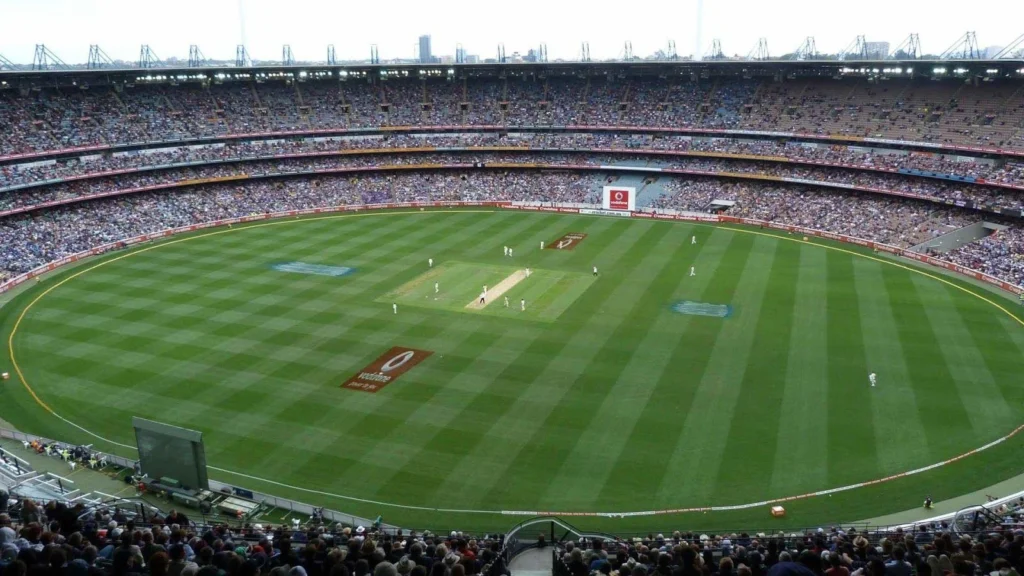
- Field: The grassy area where cricket is played.
- Fielder: A player on the fielding side, excluding the bowler and wicket-keeper.
- Fielding: The act of retrieving the ball after each delivery and attempting to prevent runs or dismiss the batter.
- Fine leg: A fielding position behind the batter on the leg side, near the boundary and close to the line of the pitch.
- Finger spin: A type of spin bowling where the ball rotates due to the action of the bowler’s fingers.
- First-class cricket: The highest level of domestic cricket, typically played over multiple days with two innings per side.
- Follow on: A team batting second in the first innings being asked to bat again immediately after their first innings if they trail by a substantial margin.
- Four: A boundary scored when the ball hits the ground before crossing the boundary rope.
- Front foot: In batting, the foot further from the stumps. In bowling, the foot that lands closest to the popping crease before releasing the ball.
G-I
- Gardening: A batter prodding the pitch with their bat between deliveries, often to flatten a bump or inspect its condition.
- Glove: Protective handwear worn by batters and wicket-keepers.
- Golden duck: A dismissal for zero runs from the first ball faced in an innings.
- Googly: A deceptive spinning delivery by a wrist spin bowler that spins in the opposite direction to their stock delivery.
- Ground: The entire cricket venue, encompassing the field, pavilion, and associated amenities. Also refers to the act of a batter touching the bat or part of their body behind the popping crease.
- Groundsman: The individual responsible for maintaining the cricket field and preparing the pitch.
- Gully: A fielding position near the slips, angled between the two sets of stumps.
- Half-century: A score of 50 or more runs by a single batter.
- Handled the ball: A dismissal occurring when the batter touches the ball with their hand while it’s in play.
- Hit wicket: A dismissal where the batter hits their own wicket with their bat or body.
I-L
- Innings: A team’s turn to bat, with ten wickets available before their innings ends.
- LBW (Leg Before Wicket): A dismissal where the ball strikes the batter’s leg before hitting the wicket, preventing it from hitting the stumps.
- Leg bye: A run scored when the ball hits the batter’s body (excluding their hand) and they run to the other end.
- Leg spin: A type of spin bowling where the ball rotates from leg to off for a right-handed bowler.
- Length: The distance the ball travels before bouncing, categorized as short, good length, or full.
- Limited overs cricket: A format of cricket where each team has a fixed number of overs to bat, typically 50 or 20.

M-O
- Maiden over: An over in which no runs are scored from the bat, and no wides or no balls are bowled.
- Match referee: An official ensuring fair play and the spirit of cricket during a match.
- Mid-off: A fielding position in front of the batter on the off side, typically positioned inside the 30-yard circle.
- Mid-on: A fielding position in front of the batter on the leg side, typically positioned inside the 30-yard circle.
- Mid-wicket: A fielding position between mid-on and square leg, often used to field shots hit to the leg side.
- Military medium: Medium-pace bowling characterized by consistent accuracy and a lack of variation.
- Net run rate (NRR): A statistic used in limited-overs cricket to compare teams based on their run rate differential.
- New ball: A new, harder ball used at the beginning of each innings and optionally after a certain number of overs.
- Nightwatchman: A lower-order batter sent in to bat near the end of a day’s play in a timed match to protect more skilled batters for the following day.
- No ball: An illegal delivery resulting in an extra run and requiring the bowler to re-bowl the delivery.
- Non-striker: The batter standing at the bowler’s end of the pitch.
- Not out: A batter who hasn’t been dismissed, remaining at the crease.
O-R
- Off break: A delivery bowled by a right-arm finger spinner that spins from off to leg.
- Off cutter: A delivery bowled by a medium-pace bowler that cuts or moves away from the batter after pitching.
- Off side: The side of the field to the right of a right-handed batter.
- Off spin: Spin bowling where the ball rotates from off to leg for a right-handed bowler.
- On side: The side of the field to the left of a right-handed batter.
- Opener: One of the two batters who begin an innings.
- Over: A set of six legal deliveries bowled by a single bowler.
- Overthrows: Extra runs awarded when a fielder throws the ball past the wicket-keeper or designated fielder while attempting a run out.
- Paddle sweep: A type of sweep shot where the batter scoops the ball over their shoulder or head.
- Partnership: The runs scored by two batters batting together before one is dismissed.
- Pavilion: The building adjacent to the field housing dressing rooms and often seating for members.
- Penalty runs: Runs added to the batting team’s score for various infringements by the fielding team.
- Pitch: The rectangular surface in the center of the field where the bowler delivers the ball and the batter attempts to strike it.
- Point: A fielding position square of the batter’s off side.

R-S
- Reverse sweep: A sweep shot played in the opposite direction to a conventional sweep.
- Reverse swing: A type of swing bowling where the ball moves in the opposite direction to conventional swing.
- Run: The basic unit of scoring in cricket.
- Run out: A dismissal where a fielder breaks the wicket while the batter is out of their crease attempting a run.
- Run rate: The average number of runs scored per over.
- Safe: A batter being within their crease or having made their ground before a fielder can break the wicket.
- Seam: The raised stitching running around the circumference of the ball.
- Seam bowling: Bowling utilizing the seam of the ball to generate movement off the pitch.
- Session: A designated period of play during a day’s match, typically divided by breaks for lunch and tea.
- Short: A delivery that bounces close to the bowler, often resulting in a bouncer.
- Shot: The act of a batter striking the ball with their bat.
- Six: A boundary scored when the ball clears the boundary rope without bouncing.
- Sledging: Verbal exchanges between players on opposing sides, often aimed at distracting or intimidating the opponent.
- Slip: A fielding position behind the batter on the off side, typically close to the wicket-keeper.
- Slog: A powerful shot, often played in the air, aimed at scoring boundaries.
- Slower ball: A delivery bowled by a fast bowler at a slower pace to deceive the batter.
- Spin bowling: A style of bowling that involves imparting spin on the ball to deceive the batter.
- Square leg: A fielding position behind the batter on the leg side, approximately at a right angle to the batter.
- Stance: A batter’s position at the crease before facing a delivery.
- Stumps: The three vertical wooden posts that constitute a wicket.
- Stumping: A dismissal where the wicket-keeper breaks the wicket with the ball in hand while the batter is out of their crease and not attempting a run.
- Strike rate: A statistic measuring how quickly a batter scores runs, calculated as runs scored per 100 balls faced.
T-Z
- Tail-ender: A lower-order batter, typically a specialist bowler or wicket-keeper, with limited batting ability.
- Target: The score the team batting second needs to surpass to win the match.
- Test cricket: The longest format of cricket, played over five days with two innings per side.
- Third man: A fielding position behind the wicket-keeper on the off side, beyond the slips and gully.
- Third umpire: An off-field umpire using technology to assist on-field umpires in making decisions.
- Toss: The coin flip determining which captain chooses to bat or field first.
- Twenty20 (T20): The shortest format of cricket, with each team batting for a maximum of 20 overs.
- Umpire: The official responsible for adjudicating the game and enforcing the Laws of Cricket.
- Wagon Wheel: A diagram illustrating the direction and distance of shots hit by a batter.
- Wicket: A set of three stumps and two bails, representing a dismissal when broken by the fielding team.
- Wicket-keeper: The fielder positioned behind the wicket, responsible for catching edges and stumping batters.
- Wide: A delivery bowled too far from the batter for them to hit, resulting in an extra run and a re-bowl.
- Yorker: A delivery that pitches under the bat and near the batter’s feet, considered difficult to play.
For more such terminologies, click here
Further Resources
To expand your knowledge of cricket, you can explore the following pages on our website:
- Cricket Rules and Regulations
- Laws of Cricket
- Cricket Fielding Positions
- Cricket Scoring System
- Cricket Formats Explained
This glossary offers a starting point for understanding the rich and diverse vocabulary of cricket. As you immerse yourself in the game, you’ll encounter many more terms that enrich your appreciation of this fascinating sport.